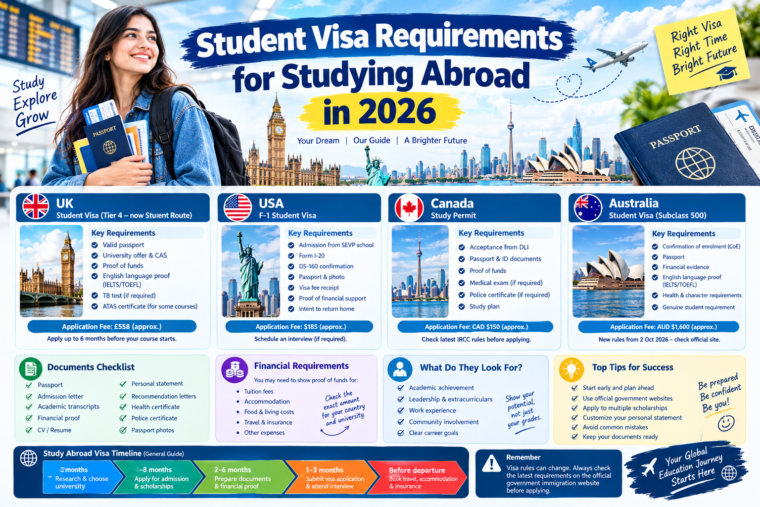
Student Visa Requirements for Studying Abroad in 2026
Studying abroad in 2026 can open the door to world-class universities, international career opportunities, and valuable cultural experiences. However, before traveling to another country for education, international students generally need to obtain the correct student visa or study permit.
Visa requirements vary by country, university, course, nationality, and financial circumstances. The most important requirements usually include an admission letter, a valid passport, proof of sufficient funds, academic documents, health or security checks where applicable, and evidence that you meet the country’s immigration requirements.
This guide explains the major student visa requirements for studying abroad in 2026, with a focus on popular destinations including the United Kingdom, United States, Canada, and Australia.
What Is a Student Visa?
A student visa is an immigration document that allows an international student to enter and remain in a country for an approved educational program.
Depending on the destination, it may be called a:
- Student Visa
- Study Permit
- F-1 Student Visa
- Subclass 500 Student Visa
- Residence Permit for Students
A student visa is different from a tourist visa. Students planning to complete a long-term academic program normally need the appropriate study authorization before beginning their studies.
General Student Visa Requirements in 2026
Although every country has its own rules, international students commonly need the following:
| Requirement | What You May Need |
|---|---|
| Valid passport | A passport valid for the required period |
| University admission | Official acceptance or enrollment confirmation |
| Proof of funds | Evidence that tuition and living costs can be covered |
| Academic documents | Transcripts, certificates, diplomas or degrees |
| Language proficiency | IELTS, TOEFL or another accepted test when required |
| Visa application | Online or paper application depending on destination |
| Photographs | Passport-style photographs where required |
| Biometrics | Fingerprints and photograph in applicable countries |
| Health documents | Medical examination or health insurance where required |
| Police documents | Police certificate or criminal-record information where required |
| Financial sponsorship | Scholarship, bank statements, education loan or sponsor evidence |
| Immigration forms | Country-specific forms and supporting documents |
Not every student will need every document. Immigration authorities may request additional evidence depending on the student’s circumstances.
UK Student Visa Requirements 2026
International students who want to study a qualifying course in the United Kingdom generally apply for a UK Student visa.
Applicants must normally have an offer from a licensed student sponsor and receive a Confirmation of Acceptance for Studies (CAS) before applying.
Main UK requirements
Students may need:
- A valid passport or travel document
- A CAS from the education provider
- Proof of sufficient funds
- Evidence of English-language ability where required
- Tuberculosis test results if applicable
- ATAS certificate for certain courses and nationalities
- Parental or guardian consent for applicants under 18
- Additional documents depending on individual circumstances
The UK government states that students applying from outside the UK can normally apply up to six months before their course begins.
The current standard Student visa application fee for applications from outside the UK is £558, in addition to applicable healthcare costs.
UK financial requirements
Students may need to demonstrate that they have enough money to pay for their course and support themselves while living in the UK. The amount required depends on the student’s circumstances and location.
Students should check the latest official UK government financial requirements immediately before submitting an application.
UK visa processing
For applications made outside the UK, the standard decision time is usually around three weeks, although processing can take longer in some circumstances.
U.S. Student Visa Requirements 2026
The United States primarily uses F-1 visas for academic students and M-1 visas for vocational students.
Before applying for a student visa, students generally need to be accepted by a school approved by the Student and Exchange Visitor Program (SEVP). The school then provides a Form I-20, and the student must be registered in SEVIS.
Main U.S. student visa requirements
Applicants generally need:
- Valid passport
- Form DS-160 confirmation
- Visa application fee payment
- Required photograph
- Form I-20
- SEVIS registration
- Academic records
- Evidence of financial ability
- Evidence explaining the intended course of study
- Evidence of intent to depart the United States after completing the program
The U.S. Department of State says consular officers may request additional documentation concerning academic preparation, finances, and the applicant’s intention to leave the United States after completing the course.
U.S. student visa interview
Applicants generally attend an interview at a U.S. embassy or consulate. Students should be prepared to explain:
- Why they selected the university
- Why they selected the course
- How they will pay for tuition and living expenses
- Their academic background
- Their career plans
- Why they intend to return or otherwise comply with U.S. immigration rules after study
The U.S. Department of State currently lists the nonimmigrant visa application fee for student visas as $185, subject to applicable fee rules.
Important 2026 U.S. update
The U.S. Department of State states that expanded online presence review already applies to several visa categories, including F-1 and M-1 students. Students should therefore review the latest official instructions before applying.
Canada Study Permit Requirements 2026
Canada generally requires international students to obtain a study permit for eligible long-term studies.
Applicants normally need an acceptance letter from a designated learning institution (DLI), along with other supporting documents.
Common Canada study permit requirements
Students may need:
- Valid passport or travel document
- Letter of Acceptance (LOA)
- Proof of financial support
- Provincial Attestation Letter (PAL) or Territorial Attestation Letter (TAL), when required
- Passport photographs
- Academic documents
- Letter of explanation or study plan where appropriate
- Medical examination where required
- Police certificate where required
- Biometrics where required
Canada requires students to demonstrate sufficient financial resources to cover tuition, living expenses and transportation.
Canada financial requirement in 2026
For applications made on or after September 1, 2026, Canada lists the annual living-expense requirement for one student outside Quebec as CAN$23,448, excluding tuition and transportation. The amount increases when family members accompany the student.
Students should always check the latest amount before applying because financial requirements can be updated.
PAL/TAL changes in 2026
One important Canadian change is that, beginning January 1, 2026, eligible master’s and doctoral students attending a public designated learning institution generally do not need a PAL/TAL. Primary and secondary students and certain other categories are also exempt.
However, many other applicants still need an applicable PAL/TAL.
Australia Student Visa Requirements 2026
International students generally apply for Australia’s Student visa (subclass 500).
Applicants must be enrolled in an eligible course and provide the required evidence of enrollment. For example, Australia requires a Confirmation of Enrolment (CoE) for intended courses when lodging a student visa application.
Common Australian student visa requirements
Students may need:
- Valid passport
- Confirmation of Enrolment (CoE)
- Evidence of financial capacity
- English-language evidence where required
- Genuine Student evidence
- Health examinations where required
- Character documents where required
- Overseas Student Health Cover (OSHC)
- Other documents requested by the Department of Home Affairs
Australia allows eligible Student visa holders to work while studying, subject to visa conditions. The current general limit is 48 hours per fortnight while the course is in session, with different rules applying to certain research master’s and doctoral students.
Important Australia update for October 2026
Australia’s Department of Home Affairs states that new Student visa application rules came into effect on October 2, 2026. These changes affect who can apply for or be granted a Student visa while in Australia and whether family members can be included in a Student visa application.
Because Australian immigration rules can change quickly, students should verify the current requirements immediately before lodging an application.
Documents Students Should Prepare Before Applying
Preparing documents early can reduce delays and help prevent mistakes.
A typical international student visa document checklist includes:
1. Passport
Your passport should be valid and have sufficient validity for your planned travel and visa requirements.
2. University Acceptance Letter
You normally need official confirmation that a university, college, or other approved educational institution has accepted you.
3. Proof of Enrollment
Depending on the country, this could be:
- UK CAS
- U.S. Form I-20
- Canadian Letter of Acceptance
- Australian Confirmation of Enrolment
4. Financial Evidence
Financial evidence can include:
- Bank statements
- Scholarship letters
- Education loans
- Sponsor letters
- Employment or income documents from a sponsor
- Tuition payment receipts
- Investment or other acceptable financial evidence
5. Academic Documents
Prepare:
- Previous degrees
- Diplomas
- Transcripts
- Certificates
- Test scores
- Other academic records requested by the university or immigration authority
6. English-Language Evidence
Depending on the university and country, students may need IELTS, TOEFL, PTE, Cambridge English, or another accepted form of English-language evidence.
7. Health and Police Documents
Some countries may require medical examinations, tuberculosis testing, police certificates, or other security-related documentation.
Does a Scholarship Guarantee a Student Visa?
No.
Receiving a scholarship or being accepted by a university does not automatically guarantee visa approval.
Immigration authorities can still evaluate:
- Financial circumstances
- Academic background
- Genuine study intentions
- Immigration history
- Health requirements
- Character or security requirements
- Completeness and accuracy of documents
A fully funded scholarship can make the financial part of an application stronger, but students must still satisfy all applicable immigration requirements.
Student Visa Interview Tips for 2026
If your destination requires an interview, preparation is important.
Be prepared to explain your study plan
Know your:
- University name
- Course name
- Course duration
- Tuition fees
- Scholarship amount
- Living-cost plan
- Career objectives
Explain your financial situation clearly
You should be able to explain who is paying for your education and where the money comes from.
Give honest answers
Do not memorize false answers or provide information that conflicts with your application.
Know your university
Research the institution, course structure, location, tuition costs and career relevance before attending the interview.
Keep your documents organized
Bring the documents requested by the embassy or immigration authority and any additional evidence that supports your application.
Common Student Visa Mistakes to Avoid
Many visa problems can be prevented by carefully checking the application before submission.
Avoid these mistakes:
- Applying with an expired passport
- Providing incorrect information
- Submitting incomplete documents
- Showing unexplained large financial deposits
- Using fraudulent documents
- Ignoring country-specific financial requirements
- Waiting until the last minute to apply
- Giving inconsistent answers during an interview
- Choosing a course that does not make sense for your academic background
- Assuming a scholarship automatically guarantees visa approval
- Ignoring updated immigration rules
When Should You Apply for a Student Visa?
Students should begin preparing well before the university’s course start date.
A practical timeline is:
| Time Before Study | Recommended Action |
|---|---|
| 9–12 months | Research universities and scholarships |
| 6–9 months | Apply to universities |
| 4–6 months | Receive admission and prepare visa documents |
| 2–6 months | Apply for the student visa when eligible |
| 1–3 months | Complete biometrics/interview or additional requirements |
| Before departure | Confirm visa, accommodation, insurance and travel documents |
The exact timeline differs by country and application type.
For example, the UK currently allows applicants outside the country to apply up to six months before their course begins.
U.S. students should also apply early because interview appointment availability varies by location and season. New F and M student visas can currently be issued up to 365 days before the course start date, although students cannot enter the United States more than 30 days before the start date.
Student Visa Requirements: UK vs USA vs Canada vs Australia
| Country | Main Student Authorization | Key Enrollment Document | Financial Evidence | Interview |
|---|---|---|---|---|
| UK | Student Visa | CAS | Usually required | May be required |
| USA | F-1/M-1 Visa | Form I-20 | Required | Generally required |
| Canada | Study Permit | Letter of Acceptance | Required | May be required |
| Australia | Student Visa 500 | CoE | Required | May be required |
Requirements can vary according to nationality, course, institution and individual circumstances.
Final Checklist Before Submitting Your Visa Application
Before submitting your student visa application, check:
☐ Passport is valid
☐ University acceptance is confirmed
☐ Required enrollment document is available
☐ Financial evidence is sufficient
☐ Academic documents are complete
☐ Language requirements are satisfied
☐ Health requirements have been checked
☐ Police/character requirements have been checked
☐ Visa application form is accurate
☐ Biometrics appointment is completed if required
☐ Interview preparation is complete if required
☐ All documents are translated when required
☐ You have checked the latest official immigration rules
Frequently Asked Questions
Can I study abroad without a student visa?
For many long-term programs, no. Students normally need the appropriate student visa, study permit, or residence authorization. The exact requirement depends on the destination and duration of study.
How much money do I need for a student visa?
There is no single worldwide amount. Each country establishes its own financial requirements, and the amount can also depend on tuition, location, course duration and accompanying family members.
Does a scholarship help with a student visa?
Yes. A recognized scholarship can provide evidence that some or all tuition and living expenses are covered. However, a scholarship does not guarantee visa approval.
Do all student visa applicants need an interview?
No. Interview requirements differ by country, visa category, nationality and individual circumstances. The United States generally requires student visa applicants to attend an interview, while other countries may request an interview only in certain cases.
Can I work while studying abroad?
Some countries allow international students to work under specific conditions. The number of permitted hours and type of employment varies by destination and visa conditions.
Can I bring my family with me?
This depends on the country’s immigration rules, your course and your visa type. Family-member rules can change, so applicants should check the current official requirements before applying.
Conclusion
Getting a student visa in 2026 requires more than simply receiving admission from a university. International students need to demonstrate that they have been accepted for an eligible course, can meet the financial requirements, have the necessary documents, and satisfy the immigration rules of their destination country.
The UK, USA, Canada and Australia remain major study destinations, but their visa systems are different and continue to change. Students should prepare their documents early and always verify the latest requirements through the official immigration website of their chosen country before submitting an application.
Important: Immigration requirements can change during the year. Always use the official government immigration website for the final requirements, fees, financial thresholds, application procedures and deadlines.
