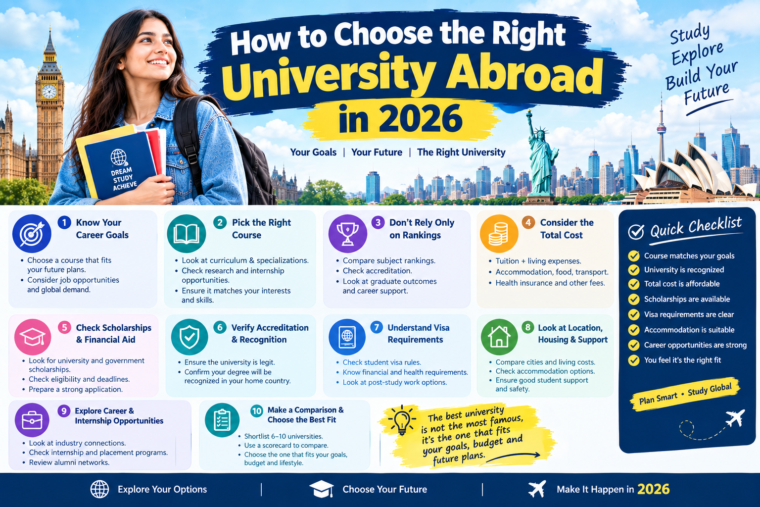
How to Choose the Right University Abroad in 2026
Choosing a university abroad is one of the most important decisions an international student can make. In 2026, students have more choices than ever, but comparing universities can also be confusing.
A university with a high global ranking may not necessarily be the best option for your particular course, budget, career goals, or lifestyle. The right choice should take into account academic quality, tuition fees, living costs, scholarships, accreditation, visa requirements, accommodation, employment opportunities, and student support.
EducationUSA recommends that students choose universities based on their academic, financial, and personal priorities rather than simply trying to attend the highest-ranked institution.
This guide explains how to choose the right university abroad in 2026 and provides a practical checklist for international students.
Why Choosing the Right University Matters
Studying abroad requires a significant investment of time and money. Your university can influence your:
- Academic development
- Professional network
- Internship opportunities
- Career prospects
- Future study options
- Living expenses
- International experience
- Post-graduation opportunities
The best university is not necessarily the most famous one. It is the institution that provides the right combination of education, affordability, career opportunities, and personal fit.
1. Decide What You Want to Study
Before choosing a university, decide what subject and degree you want.
For example, you may want to study:
- Computer Science
- Artificial Intelligence
- Engineering
- Business
- Finance
- Medicine
- Nursing
- Law
- Data Science
- Cybersecurity
- Environmental Science
Start with the course, rather than the university name.
A university may have an excellent overall reputation but may not be particularly strong in your specific subject.
Questions to ask
- Does the university offer my preferred degree?
- Are the course modules relevant to my career?
- Does the program offer practical training?
- Are internships available?
- Does the university have strong faculty in my field?
- Are research opportunities available?
Current study-abroad guidance also recommends comparing the actual course and academic requirements rather than selecting a destination based only on language-test scores or rankings.
2. Consider Your Career Goals
Your university choice should support your long-term career plans.
Think about where you want to be five or ten years after graduation.
For example:
Computer Science student:
Look for technology companies, internships, AI research, software projects, and strong computing facilities.
Business student:
Look for employer connections, internships, business competitions, and strong alumni networks.
Engineering student:
Research laboratories, industry partnerships, practical projects, and professional accreditation may be particularly important.
Healthcare student:
Check professional accreditation, clinical training, licensing requirements, and placement opportunities.
A good university should help you move from education toward your desired career.
3. Don’t Choose Only by University Ranking
University rankings can be useful when creating a shortlist, but they should not make the final decision for you.
Different ranking systems measure different factors, and a university’s overall ranking does not necessarily tell you how strong its specific course is.
When comparing universities, consider:
| Factor | Why It Matters |
|---|---|
| Overall ranking | General reputation |
| Subject ranking | Strength in your field |
| Course content | Relevance to your goals |
| Accreditation | Recognition of the qualification |
| Graduate outcomes | Career prospects |
| Research | Important for research-focused students |
| Industry links | Internship and employment opportunities |
| Cost | Overall affordability |
| Location | Lifestyle and living expenses |
| Student support | Helps international students adapt |
Recent 2026 guidance similarly recommends looking beyond rankings and considering course content, location, cost of living, visa rules, graduate outcomes, and student support.
4. Check Accreditation and Recognition
Before applying, make sure the university and your specific program are officially recognized.
This is particularly important for regulated professions such as:
- Medicine
- Nursing
- Engineering
- Law
- Pharmacy
- Teaching
- Architecture
An internationally recognized qualification can make it easier to use your degree for further study or employment.
If you plan to return to your home country after graduation, also check whether the qualification will be recognized by the relevant authorities or professional organizations in your country.
5. Calculate the Complete Cost
Don’t compare universities based on tuition fees alone.
Your total study-abroad budget can include:
- Tuition fees
- Accommodation
- Food
- Transportation
- Health insurance
- Visa fees
- Flights
- Books
- Internet and phone costs
- Personal expenses
- Emergency funds
Example
| Expense | Example Annual Budget |
|---|---|
| Tuition | $18,000 |
| Accommodation | $8,000 |
| Food | $4,000 |
| Transportation | $1,200 |
| Insurance | $1,000 |
| Books and supplies | $700 |
| Personal expenses | $2,000 |
| Estimated total | $34,900 |
These numbers are only an example. Actual expenses vary significantly by country, university, city, course, and lifestyle.
A university with lower tuition may actually be more expensive if it is located in a very expensive city.
6. Compare the Cost of Living
The university’s city can have a major effect on your finances.
Research:
- Average rent
- Student accommodation
- Grocery prices
- Public transportation
- Healthcare
- Mobile phone plans
- Entertainment
- Local taxes where applicable
For example, studying in a smaller city may cost considerably less than studying in a major international city.
Before applying, calculate your expected annual cost of living, not just tuition.
7. Look for Scholarships and Financial Aid
Scholarships can significantly reduce the cost of studying abroad.
Look for:
- Fully funded scholarships
- Tuition scholarships
- Merit-based awards
- Need-based financial aid
- Government scholarships
- University scholarships
- Research funding
- Graduate assistantships
- Department-level funding
Don’t wait until you receive admission to start researching funding.
Some scholarships have deadlines earlier than university applications.
Create a spreadsheet containing:
| Scholarship | Deadline | Funding | Eligibility | Status |
|---|---|---|---|---|
| Scholarship A | October | Full | Master’s | Preparing |
| Scholarship B | November | Tuition | International students | Researching |
| Scholarship C | January | Partial | Merit-based | Not started |
Always confirm current deadlines directly with the scholarship provider.
8. Check Admission Requirements
Every university has its own admission requirements.
Depending on the degree and country, you may need:
- Academic transcripts
- Previous degree or diploma
- Minimum GPA
- English-language test
- Personal statement
- Recommendation letters
- CV or résumé
- Portfolio
- Entrance examination
- Research proposal
- Work experience
International students should carefully compare their qualifications with the university’s official requirements.
If English is not your first language, check whether IELTS, TOEFL, PTE, or another approved test is required.
9. Check the Student Visa Requirements
Admission to a university does not automatically guarantee a student visa.
Before selecting a destination, research:
- Student visa requirements
- Financial requirements
- Health requirements
- Language requirements
- Required documents
- Student work restrictions
- Dependent/family rules
- Post-study work options
Immigration requirements can change, so students should always check the official government immigration website before applying.
This is especially important in 2026 because major study destinations have introduced or adjusted international student policies.
10. Research Post-Study Work Opportunities
If gaining international work experience after graduation is part of your plan, investigate the country’s current post-study options.
Research:
- Graduate work visas
- Post-study work periods
- Employer sponsorship
- Internship opportunities
- Graduate employment
- Industry demand
- Professional licensing
Do not assume today’s immigration rules will remain unchanged throughout your degree.
Use current rules as part of your decision, but choose a university that remains valuable to you academically even if immigration policies change.
11. Investigate Accommodation
Accommodation can become one of the biggest challenges for international students.
Before choosing a university, find out:
- Does the university offer student housing?
- Is accommodation guaranteed?
- How much does it cost?
- How early should you apply?
- How far is it from campus?
- Are private rentals available?
- Are utilities included?
- Is public transportation nearby?
Housing availability should be considered before accepting an offer, particularly in expensive or highly competitive student cities.
12. Check International Student Support
Moving to another country can be challenging.
A university with strong international student support can make the transition easier.
Look for:
- International student offices
- Orientation programs
- Academic advisers
- Career services
- Mental health support
- Language assistance
- Cultural activities
- Student clubs
- International student communities
Ask current students whether these services are actually useful rather than simply relying on the university’s promotional material.
13. Compare Internship Opportunities
A degree is important, but practical experience can also have a major effect on your career.
Check whether universities offer:
- Internships
- Work placements
- Employer partnerships
- Career fairs
- Industry projects
- Research placements
- Graduate recruitment events
A university with strong employer connections may provide valuable opportunities to gain professional experience before graduation.
14. Research the University’s Alumni Network
An active alumni network can help students build professional connections.
Research:
- Where graduates work
- Major companies employing alumni
- Alumni mentoring programs
- Networking events
- International alumni chapters
- Graduate entrepreneurship
Search for graduates from your specific course rather than looking only at the university’s most famous alumni.
15. Consider the Location
The university’s location will become part of your everyday life.
Think about:
Safety
Research the university area and surrounding neighborhoods.
Transportation
Check whether you can easily travel between your accommodation, campus, airport, and city center.
Climate
Consider whether you can comfortably live in the local climate.
Culture
Research food, language, social customs, and the local community.
Employment
Major cities may offer more internships but can also have higher living costs.
Distance from home
If you plan to return home regularly, consider flight availability and travel costs.
16. Compare Teaching Methods
Universities can have very different teaching styles.
Some programs rely heavily on:
- Lectures
- Seminars
- Laboratories
- Group projects
- Presentations
- Online learning
- Independent research
Think about how you learn best.
If you prefer personal interaction with professors, investigate class sizes and faculty accessibility.
If you want practical experience, look for courses with laboratories, projects, placements, or internships.
17. Talk to Current Students
University websites provide useful information, but current students can give you a more realistic picture.
Ask students about:
- Actual living costs
- Accommodation
- Course workload
- Teaching quality
- Campus life
- International student support
- Part-time work
- Transportation
- Career services
You can contact students through official university student organizations, events, alumni networks, or verified student communities.
18. Create a University Shortlist
After your research, create a shortlist of around 6–10 universities.
Divide them into three categories:
Reach Universities
Highly competitive universities where admission may be difficult.
Target Universities
Universities where your academic profile is reasonably aligned with the admission requirements.
Backup Universities
Options where you have a stronger chance of meeting admission requirements.
This strategy reduces the risk of depending entirely on one university.
University Comparison Scorecard
Use a simple scoring system from 1 to 5.
| Factor | University A | University B | University C |
|---|---|---|---|
| Course quality | /5 | /5 | /5 |
| Accreditation | /5 | /5 | /5 |
| Tuition affordability | /5 | /5 | /5 |
| Living costs | /5 | /5 | /5 |
| Scholarships | /5 | /5 | /5 |
| Career opportunities | /5 | /5 | /5 |
| Internship opportunities | /5 | /5 | /5 |
| Student support | /5 | /5 | /5 |
| Accommodation | /5 | /5 | /5 |
| Location | /5 | /5 | /5 |
| Visa suitability | /5 | /5 | /5 |
| Total | /55 | /55 | /55 |
This gives you a more balanced comparison than looking at rankings alone.
10 Questions to Ask Before Applying
Before submitting an application, ask yourself:
- Is this university recognized?
- Is my specific course accredited?
- Does the course match my career goals?
- Can I afford the total cost?
- Can I afford the city’s living expenses?
- What scholarships are available?
- Do I meet all admission requirements?
- Can I meet the student visa requirements?
- What career and internship opportunities are available?
- Is this university still a good choice if immigration rules change?
If you cannot answer these questions, continue researching before making a final decision.
Common Mistakes Students Should Avoid
Choosing only by ranking
A high ranking does not guarantee that the university is the right fit for your course or budget.
Looking only at tuition
Living expenses can add thousands of dollars to your annual budget.
Ignoring accreditation
Always verify recognition before committing to a degree.
Applying too late
Late applications can create problems with admission, scholarships, accommodation, and visas.
Ignoring housing
Finding affordable accommodation can be difficult in popular student cities.
Assuming admission guarantees a visa
University admission and immigration approval are separate processes.
Choosing a university without considering career goals
A degree should support your future career rather than simply provide an impressive university name.
Best Timeline for Choosing a University Abroad in 2026
A practical preparation timeline is:
| Period | What to Do |
|---|---|
| 12–18 months before study | Research countries and courses |
| 10–12 months | Build university shortlist |
| 8–10 months | Check admission and scholarship requirements |
| 6–9 months | Take required language tests |
| 4–8 months | Submit applications |
| After admission | Compare offers and funding |
| After accepting | Begin visa and accommodation preparation |
| Before departure | Finalize travel, housing, insurance and documents |
EducationUSA recommends beginning U.S. university research around 12–18 months before the academic year of intended enrollment, illustrating why early preparation is valuable.
Final Checklist
Before choosing your university, make sure:
☐ I know what subject I want to study
☐ The course supports my career goals
☐ The university is recognized
☐ My program meets professional requirements if applicable
☐ I meet the admission requirements
☐ I know the complete tuition cost
☐ I calculated living expenses
☐ I researched scholarships
☐ I checked student visa requirements
☐ I researched accommodation
☐ I compared internship opportunities
☐ I checked career services
☐ I researched post-study options
☐ I compared several universities
☐ I have backup choices
Frequently Asked Questions
What is the most important factor when choosing a university abroad?
The most important factor is usually the overall fit between the university, your course, career goals, finances, and personal circumstances.
Should I choose a university based on its ranking?
Rankings can help you create a shortlist, but they should not be the only deciding factor. Course quality, accreditation, cost, location, career opportunities, and student support are also important.
How many universities should I apply to?
There is no fixed number. A balanced list containing ambitious, realistic, and backup options can reduce your risk.
Is a cheaper university always better?
No. Compare the total value of the degree, including tuition, living costs, academic quality, career opportunities, scholarships, and location.
Should I choose a university in a major city?
Not necessarily. Major cities may provide more employment and internship opportunities but often have higher living costs. Smaller cities can sometimes provide a more affordable student experience.
When should I start researching universities?
Ideally, start 12 months or more before your intended intake. Competitive programs and scholarships may require even earlier preparation.
Can international students work while studying?
Some countries allow international students to work under specific visa conditions. The number of permitted hours and other restrictions vary by country and can change, so always check current government rules.
Conclusion
Choosing the right university abroad in 2026 requires much more than checking a global ranking.
Start with your course and career goals, then compare academic quality, accreditation, tuition, living expenses, scholarships, accommodation, visa requirements, internships, student support, and career opportunities.
The best university is not necessarily the most famous university. It is the one that gives you the strongest combination of education, affordability, career value, and personal fit.
Research carefully, compare multiple options, and verify important information through official university and government sources before making your final decision.
