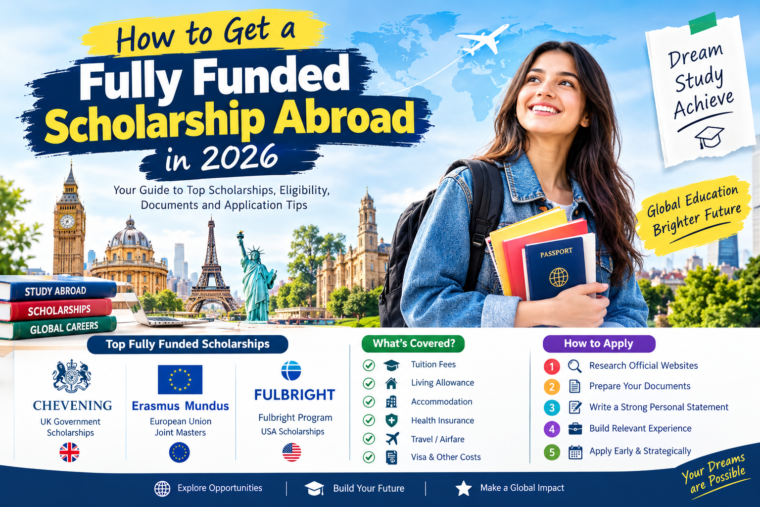
Studying abroad can be expensive, but a fully funded scholarship can cover most or all of the major costs, including tuition, accommodation or living expenses, travel, insurance, and other study-related costs.
In 2026, international students have access to major scholarship programs in the UK, Europe, the United States, Australia, Canada, and other destinations. However, these scholarships are highly competitive, so students need a strong academic profile, carefully prepared documents, and a clear study and career plan.
This guide explains how to get a fully funded scholarship abroad in 2026, where to find opportunities, what documents you need, how to write a strong application, and which major scholarship programs international students should consider.
What Is a Fully Funded Scholarship?
A fully funded scholarship is an award designed to cover most or all essential costs associated with studying abroad.
Depending on the scholarship, funding may include:
- Full or partial tuition fees
- Monthly living allowance
- Accommodation support
- Airfare or travel allowance
- Health insurance
- Visa-related expenses
- Study or research allowances
- Books and academic materials
- Relocation or installation support
The exact benefits vary by program. For example, Chevening currently covers tuition fees, travel, visa costs, and a monthly living allowance for successful scholars.
Erasmus Mundus Joint Masters scholarships can contribute toward participation costs as well as travel, visa, and living expenses.
Best Fully Funded Scholarships Abroad in 2026
Several major international scholarship programs are worth researching in 2026.
| Scholarship | Destination | Typical Level | Main Funding |
|---|---|---|---|
| Chevening | UK | Master’s | Tuition, living costs, travel and other allowances |
| Erasmus Mundus Joint Masters | Europe | Master’s | Participation costs, travel, visa and living support |
| Fulbright Foreign Student Program | USA | Master’s/Doctorate | Funding support, J-1 sponsorship and health benefits |
| Commonwealth Scholarships | UK | Master’s/PhD | Tuition, travel, living allowance and other support |
| University-funded scholarships | Various | Bachelor’s/Master’s/PhD | Varies by university |
Always check the individual scholarship’s official website because eligibility, deadlines, funding and participating institutions can change.
1. Chevening Scholarship – UK
Chevening is one of the best-known fully funded scholarship programs for international students who want to study a one-year master’s degree in the United Kingdom.
Chevening describes its scholarships as fully funded and says the program supports outstanding emerging leaders from around the world.
What does Chevening cover?
The award can include:
- University tuition fees
- Return economy travel
- Arrival allowance
- Visa application cost
- Departure allowance
- Travel top-up allowance
- Monthly living allowance
- TB testing contribution where applicable
2026–27 application deadline
For the current 2027–28 Chevening cycle, applications opened on 4 August 2026 and close on 6 October 2026 at 11:00 UTC.
Students should check their country’s Chevening page because eligibility and country-specific information can apply.
For example, the official Pakistan page confirms that applications for Pakistani applicants are open until 6 October 2026 at 11:00 UTC.
Who should apply?
Chevening is particularly suitable for applicants who can demonstrate:
- Leadership potential
- Professional experience
- Academic ability
- A clear career plan
- A desire to create positive change
- Strong communication and networking skills
It is specifically designed for one-year master’s study in the UK.
2. Erasmus Mundus Joint Masters – Europe
The Erasmus Mundus Joint Masters program is another major opportunity for international students.
These master’s programs are jointly delivered by universities in multiple countries. Students may study in several European countries during the same degree.
The European Commission states that students from around the world can apply and that full scholarships are available for the best-ranked students.
What can Erasmus Mundus scholarships cover?
Depending on the specific program, scholarship support can contribute toward:
- Participation costs
- Travel
- Visa expenses
- Living allowance
Erasmus Mundus Joint Masters normally last between 1 and 2 academic years.
When should you apply?
Most Erasmus Mundus programs accept applications between October and January for courses beginning the following academic year, although individual programs set their own deadlines.
This means students planning for a future intake should begin researching programs several months before applications open.
3. Fulbright Foreign Student Program – USA
The Fulbright Foreign Student Program provides opportunities for international students to study and conduct research in the United States.
The program operates in more than 160 countries and awards approximately 4,000 foreign student grants each year.
Fulbright funding can include
The official program lists benefits such as:
- J-1 visa sponsorship
- Funding support
- Health benefit plan
- Enrichment activities
Eligibility and application procedures differ by country. Applications are generally handled through the relevant Fulbright Commission, Foundation, or U.S. Embassy.
Students should therefore select their home country on the official Fulbright website and follow the specific instructions provided there.
4. Commonwealth Scholarships – UK
The Commonwealth Scholarship Commission (CSC) offers several scholarship programs for students from eligible Commonwealth countries.
These include:
- Commonwealth Master’s Scholarships
- Commonwealth PhD Scholarships
- Commonwealth Shared Scholarships
- Other specialized awards
Commonwealth scholarships are generally targeted at applicants from eligible low- and middle-income Commonwealth countries and focus on development-related impact.
What can Commonwealth Scholarships cover?
The CSC states that Commonwealth Scholarships cover approved tuition fees. For UK-based study, the CSC also covers airfare, visa costs and a living allowance, with additional support depending on the specific award.
Pakistan and Commonwealth Scholarships
Pakistan is included among the eligible Commonwealth countries for relevant scholarship schemes.
Applicants should carefully check the individual scholarship’s eligibility requirements because some programs have different academic, country and course conditions.
How to Find Fully Funded Scholarships
Finding the right scholarship is often the first major challenge.
Instead of relying only on random scholarship websites or social-media posts, use a structured approach.
Search official scholarship websites
Start with:
- Government scholarship programs
- University scholarship pages
- European scholarship databases
- Embassy and education-center websites
- Official scholarship organizations
- Department-specific funding pages
Always verify the scholarship on the organization’s official website before submitting personal information or paying any fee.
Search by Your Degree Level
Your degree level can dramatically change which scholarships are available.
Bachelor’s students
Look for:
- University merit scholarships
- Government scholarships
- Need-based scholarships
- International student awards
- Tuition-waiver programs
Master’s students
Master’s applicants have access to some of the largest international scholarship programs, including:
- Chevening
- Erasmus Mundus
- Fulbright
- Commonwealth scholarships
- University-funded awards
PhD students
PhD applicants should investigate:
- Fully funded doctoral positions
- Research assistantships
- Teaching assistantships
- Government scholarships
- University research grants
- Supervisor-funded projects
Build a Strong Academic Profile
Scholarships can receive thousands of applications, so academic preparation matters.
A strong applicant may have:
- Good grades
- Relevant academic qualifications
- Research experience
- Internships
- Professional experience
- Leadership activities
- Volunteer work
- Publications or projects where relevant
- Strong English-language ability
However, grades are not always the only factor.
Many competitive scholarships also look for leadership, development impact, professional experience, research potential or a strong connection between the applicant’s goals and the scholarship’s objectives.
Write a Powerful Personal Statement
Your personal statement can be one of the most important parts of your application.
Avoid writing a generic essay that could be submitted to every university.
Instead, explain:
Your background
What experiences shaped your academic and professional interests?
Your achievements
What have you accomplished so far?
Your motivation
Why do you want to study this particular subject?
Why this university or program?
Explain how the course fits your goals.
Your future plans
What do you plan to do after graduation?
Your expected impact
How will your education benefit your community, country, industry or field?
A strong scholarship essay should tell a clear story rather than simply listing achievements.
Get Strong Recommendation Letters
Many scholarships require references or recommendation letters.
Choose people who know your work well, such as:
- University professors
- Research supervisors
- Employers
- Managers
- Professional mentors
A strong recommendation should provide specific examples of your abilities instead of simply saying that you are a “good student.”
Give your referees enough time to prepare their letters and provide them with your CV, scholarship details and application goals.
Prepare Your Documents Early
A typical scholarship application may require:
| Document | Purpose |
|---|---|
| Passport | Identity and nationality |
| Academic transcripts | Academic performance |
| Degree certificate | Proof of previous education |
| CV/resume | Academic and professional background |
| Personal statement | Motivation and goals |
| Recommendation letters | Independent assessment |
| English test | Language ability where required |
| Research proposal | Required for some programs |
| Work experience evidence | Required by some scholarships |
| Portfolio | Required for selected subjects |
Not every scholarship requires all of these documents.
Always follow the official checklist for the specific program.
Apply to More Than One Scholarship
One of the biggest mistakes students make is applying to only one scholarship.
Fully funded scholarships are competitive, so consider creating a portfolio of applications.
For example:
- 2–3 highly competitive scholarships
- 3–5 university scholarships
- Several country-specific opportunities
- Department-level funding
- Research-based opportunities
However, never submit the exact same application everywhere.
Customize your personal statement and study plan for each scholarship.
Create a Scholarship Calendar
Deadlines are easy to miss when applying to several programs.
Create a simple spreadsheet containing:
| Scholarship | Country | Degree | Opening Date | Deadline | Documents | Status |
|---|---|---|---|---|---|---|
| Chevening | UK | Master’s | August | October | CV, essays, references | Prepare |
| Erasmus Mundus | Europe | Master’s | Varies | Usually Oct–Jan | Varies | Research |
| Fulbright | USA | Master’s/PhD | Country-specific | Country-specific | Varies | Check |
| Commonwealth | UK | Master’s/PhD | Varies | Varies | Academic + supporting documents | Research |
Dates change between programs and cycles, so use this table as a planning framework rather than a substitute for the official deadline.
How to Improve Your Chances of Winning
There is no guaranteed formula for winning a scholarship, but you can make your application more competitive.
1. Choose a scholarship that fits your profile
Do not apply simply because the scholarship is fully funded.
Check:
- Degree requirements
- Nationality requirements
- Work experience
- Academic requirements
- Age requirements if applicable
- Subject restrictions
- Leadership criteria
- Development objectives
2. Match your goals with the scholarship
If a scholarship emphasizes development impact, explain exactly how your education will contribute to that goal.
3. Use specific examples
Instead of writing:
“I am a great leader.”
Explain what you actually did, who benefited, and what result you achieved.
4. Demonstrate future impact
Scholarship committees want to understand what happens after you receive the degree.
Explain:
- What problem you want to solve
- What skills you need
- How the degree will help
- What you plan to do after graduation
5. Proofread everything
Spelling and grammar mistakes can make an otherwise strong application look careless.
Read your application several times before submitting it.
Fully Funded Does Not Always Mean Every Expense Is Covered
The phrase “fully funded” can mean different things depending on the scholarship.
One program might cover:
- Tuition
- Living allowance
- Travel
Another might cover tuition but provide only limited living support.
Therefore, before accepting an award, check:
- Tuition coverage
- Monthly stipend
- Accommodation
- Flights
- Visa costs
- Insurance
- Family support
- Research expenses
- Initial relocation costs
For example, Erasmus Mundus scholarship support and Chevening funding have specific components rather than being an unlimited payment for every possible expense.
Beware of Scholarship Scams
Students should be particularly careful with websites or social-media accounts promising guaranteed scholarships.
Red flags include:
- “Guaranteed scholarship”
- “Pay us and we will guarantee selection”
- Requests for cryptocurrency payments
- Unofficial email addresses
- Fake acceptance letters
- Requests for unnecessary passport information
- Pressure to pay immediately
- No official scholarship website
A legitimate scholarship should be independently verifiable through the official university, government or scholarship organization’s website.
2026 Scholarship Application Strategy
If you want to start your scholarship journey in 2026, follow this process:
Step 1: Choose your target country
Select two or three countries where your subject is strong.
Step 2: Select your degree
Decide whether you are looking for:
- Bachelor’s
- Master’s
- PhD
Step 3: Find suitable scholarships
Search official government and university websites.
Step 4: Check eligibility
Do this before spending significant time on an application.
Step 5: Prepare your documents
Collect transcripts, certificates, CV, references and test scores.
Step 6: Build your personal story
Connect your past experiences with your academic goals and future plans.
Step 7: Apply early
Do not wait until the final day.
Step 8: Track every application
Maintain a spreadsheet with deadlines and submission status.
Step 9: Prepare for interviews
Some scholarships use interviews or additional selection stages.
Step 10: Verify the final offer
Read the scholarship terms carefully to understand exactly what is funded.
Fully Funded Scholarship Checklist
Before submitting your application, check:
☐ I meet the nationality requirements
☐ I meet the academic requirements
☐ My degree matches the scholarship
☐ I meet the work-experience requirement if applicable
☐ My passport is valid
☐ My academic transcripts are ready
☐ My CV is updated
☐ My personal statement is customized
☐ My recommendation letters are ready
☐ My English-language test is available if required
☐ My research proposal is ready if required
☐ I checked the official deadline
☐ I checked exactly what the scholarship covers
☐ I submitted the application successfully
☐ I saved a copy of my application
Frequently Asked Questions
Can I get a fully funded scholarship without work experience?
Yes, depending on the scholarship. Some programs do not require professional experience, while others specifically target professionals or emerging leaders. Always check the individual eligibility criteria.
Can international students get fully funded scholarships?
Yes. Major programs such as Erasmus Mundus and Fulbright explicitly accept international applicants, while Chevening and Commonwealth scholarships are available to eligible applicants from participating countries.
Which country offers the most fully funded scholarships?
There is no single country that offers the most opportunities for every student. The best destination depends on your degree level, subject, nationality and academic profile.
Can I apply for several scholarships at the same time?
In many cases, yes. However, each scholarship has its own rules concerning other awards and funding. Always read the terms before accepting multiple scholarships.
Is IELTS required for every fully funded scholarship?
No. English-language requirements vary by scholarship, university and country. Some programs require a recognized language test, while others may accept alternative evidence.
Can a low GPA student get a fully funded scholarship?
It can be difficult, but not necessarily impossible. Some scholarships consider professional experience, leadership, research, community involvement and future impact in addition to academic performance.
Do fully funded scholarships cover visa costs?
Some do and some do not. For example, Chevening currently includes the cost of the visa application in its award, while other programs have different funding arrangements.
Conclusion
Getting a fully funded scholarship abroad in 2026 is possible, but successful applicants usually start preparing well before the deadline.
The most important steps are to find scholarships that match your profile, carefully check eligibility, prepare strong documents, write a convincing personal statement, obtain quality references, and submit applications before the deadline.
Programs such as Chevening, Erasmus Mundus, Fulbright and Commonwealth Scholarships provide some of the most significant opportunities for international students. However, competition is high, so applicants should not depend on one scholarship alone.
Start early, apply strategically, and always verify the latest requirements directly from the official scholarship provider.
